
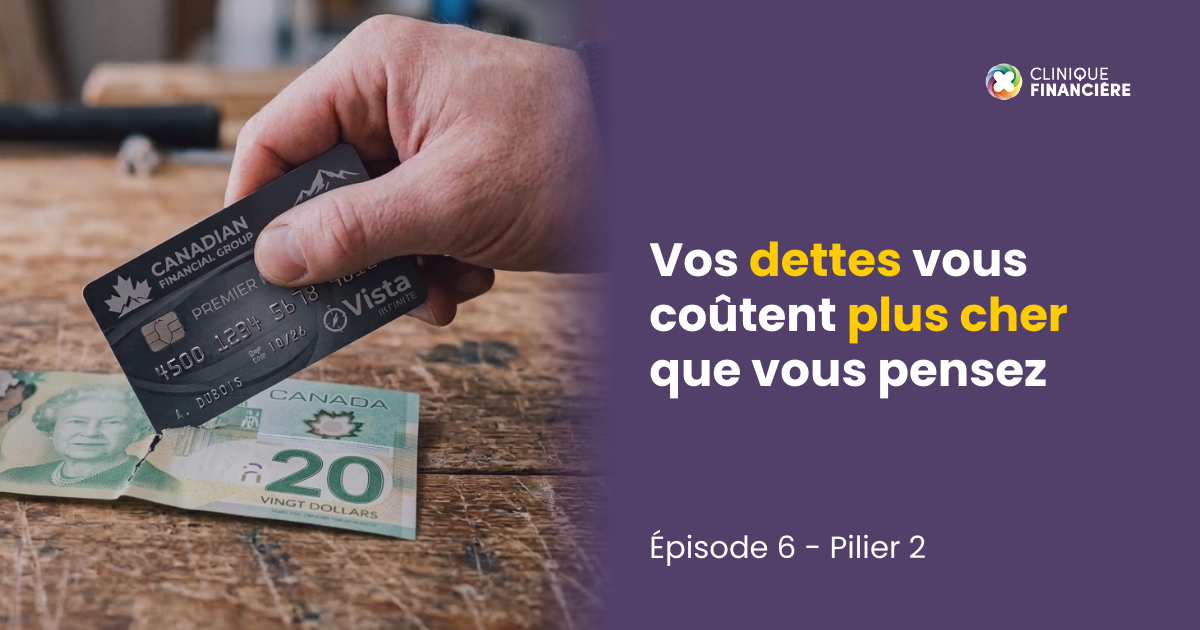
Pay off your debts or invest: which should you do first?
Paying off a credit card debt at 20% is exactly like earning a 20% return on your money. Think about that for a second. Every dollar you pay off on your Visa "earns" you 20 cents per year in saved interest. No legal investment in the world beats that. Not the stock market, not real estate, not Bitcoin, not your cousin's miracle TFSA. Nothing.
And yet, here's the paradox I see every week: people chasing the best investment at 6-8% returns while carrying credit card debt at 20%. It's like trying to fill a bathtub without putting in the plug. Water flows in, water flows out — and at the end of the day, the tub stays empty.
Take the test now: our 7 Pillars Scan evaluates your financial health in 5 minutes, for free. Or book a 15-minute discovery call with an advisor — no pressure, no commitment.
If you have high-interest debt, this episode is the most important one in the series for you. We're going to take apart the debt machine piece by piece, understand the difference between debt that helps you and debt that crushes you, and most importantly, build a concrete plan to break free. No judgment, no lectures — just numbers and an action plan.
Take the example of Chantal, 41, from Gatineau. She earns $58,000 per year. She's been contributing $200/month to her RRSP for 3 years. Good habit, right? Except she's also carrying $7,200 on her credit card at 21%. Her RRSP contributions might generate 6 to 8% returns — let's say $480 per year in gains. Meanwhile, her credit card debt costs her $1,512 per year in interest. She's losing $1,032 net every year by trying to do both at the same time. It's like trying to walk up a down escalator — you're taking steps, but you're still going backwards.
In the previous episode, we talked about the emergency fund as pillar number 1. Now that we have a safety net (even a small one), it's time to tackle what's eating away at your budget every month: your debts.
Good debt or bad debt: how to tell them apart?
You often hear "debt is bad." That's a shortcut that isn't always true. Some debts work for you. Others work against you. The difference is crucial.
Think of it this way: a good debt is a lever that multiplies your strength. You borrow to buy an asset that grows in value or increases your ability to earn income. A bad debt is an anchor that drags you to the bottom. You borrow to consume something that loses value instantly, and you pay interest on it for years.
| Type of debt | Typical rate | Category | Why |
|---|---|---|---|
| Mortgage | 3-6% (source: Bank of Canada) | Good | Asset that grows in value over the long term. Interest rates are relatively low. |
| Student loan | 3-7% | Neutral | Investment in human capital. Increases your lifetime earning potential. |
| Car loan (new vehicle) | 5-8% | Caution | The car loses 20% of its value in the first year. You're financing a melting asset. |
| Personal line of credit | 7-12% | Bad | Often used for consumption. No fixed repayment schedule = you never pay it off. |
| Credit card | 19-22% (source: FCAC) | Toxic | Compound interest working AGAINST you. The minimum payment trap. |
| Payday loan | 300-500% (source: FCAC) | Catastrophic | A legalized trap. Astronomical cost. Avoid at all costs. |
Can your mortgage become a bad debt?
Yes, a mortgage is generally a "good debt," but with a caveat. If you buy a house that's too expensive for your budget, your payments eat up 45% of your income, and you have zero wiggle room, your "good debt" turns into a gilded cage. The lever can become an anchor if you use it poorly.
Is a car loan at 6% really reasonable?
Many people think financing a new car at "only" 6% is reasonable. But let's do the math: a $35,000 loan over 7 years at 6% costs you about $7,800 in interest. And the car that was worth $35,000 new is only worth about $14,000 after 7 years. You've paid $42,800 (principal + interest) for something worth $14,000. That $28,800 difference has evaporated. Compare that with a 3-year-old used car bought for $20,000: same reliability, same driving enjoyment, but $15,000 less to finance. Over 5 years, the difference is dramatic.
Why are payday loans so dangerous?
Borrowing $300 from a payday lender typically costs $45 to $60 for two weeks. It seems harmless, but annualized, that's a rate of 390 to 520%. It's legal, but it's designed to trap you in a cycle of dependency. You borrow $300, you repay $360 two weeks later, and since you're now short $360, you borrow again. And the cycle starts over, week after week. Some people pay thousands of dollars per year in fees on amounts they could have covered otherwise. If you're in this situation, it's a red flag and solutions do exist. Check out our article on toxic debt and how to regain control.
What does the minimum payment on $5,000 really cost?
Here's the most eye-opening exercise you'll do today. Let's take a pretty common balance: $5,000 on a credit card at 20% interest. You make the minimum payment, which is 2% of the balance (minimum $25).
Let's look at the first few months:
- Month 1: Balance $5,000. Monthly interest: $83.33. Minimum payment (2%): $100. Actual principal repaid: $16.67. New balance: $4,983.33.
- Month 2: Balance $4,983.33. Interest: $83.06. Minimum payment: $99.67. Principal repaid: $16.61. New balance: $4,966.72.
- Month 3: Balance $4,966.72. Interest: $82.78. Minimum payment: $99.33. Principal repaid: $16.55. New balance: $4,950.17.
See the problem? After three months of faithful payments, you've paid almost $300... and your balance has only dropped by $50. 83% of every payment goes to interest. (source: FCAC, understanding credit cards) You're running on a financial treadmill: you're spending energy, but you're not getting anywhere.
And here's the terrifying conclusion: at this rate, paying off that $5,000 takes about 33 years and costs about $15,000 in interest (source: FCAC, credit cards). Total paid: nearly $20,000. For $5,000 borrowed. You've paid four times the price.
What happens if you pay more than the minimum?
| Repayment strategy | Duration | Interest paid | Total cost | Savings vs. minimum |
|---|---|---|---|---|
| Minimum payment (2%) | ~33 years | ~$15,000 | ~$20,000 | — |
| Fixed $200/month | 2 and a half years | ~$1,200 | ~$6,200 | $13,800 |
| Fixed $500/month | 11 months | ~$450 | ~$5,450 | $14,550 |
You save $13,800 just by going from the minimum payment to $200 per month. It's not even a huge sacrifice — it's the equivalent of $50 per week, or one less stop at the corner store per day. The minimum payment is a trap designed by credit card companies to maximize their profits, not yours.
How to eliminate $35,000 in debt in 24 months?
Patrick is 29 years old. He lives in Longueuil. He works in a warehouse, good salary of $52,000 per year. On the surface, he's doing fine. But here's his debt picture:
- Visa card: $5,200 at 19.99%. Minimum payment: $104/month.
- Mastercard: $3,800 at 21.99%. Minimum payment: $76/month.
- Electronics store card: $3,000 at 29.99%. Minimum payment: $90/month.
- Car loan: $18,000 at 6.9%. Payment: $380/month.
- Line of credit: $5,000 at 9.5%. Minimum payment: $200/month.
Total debt: $35,000. Total monthly payments: $850.
But here's what Patrick doesn't realize: of his $850 in monthly payments, about $375 goes to interest. Only $475 actually reduces his debts. He's running on a treadmill: he's making huge efforts and barely moving forward.
If Patrick continues with minimum payments everywhere, it will take him more than 15 years to be debt-free. And he'll have paid over $28,000 in interest — almost as much as the debt itself.
How does the avalanche method actually work?
Patrick decides to take control. He keeps his total payment budget at $850, but instead of spreading it evenly, he puts the maximum toward the debt with the highest rate (the store card at 29.99%) while making the minimum on everything else.
| Step | Target debt | Rate | Time to eliminate | Action |
|---|---|---|---|---|
| 1 | Store card | 29.99% | ~7 months | $400/month (minimum on the rest) |
| 2 | Mastercard | 21.99% | ~6 months | The freed-up $400 is added to the MC minimum |
| 3 | Visa | 19.99% | ~5 months | The snowball effect continues |
| 4 | Line of credit | 9.5% | ~3 months | Almost the entire budget goes here |
| 5 | Car loan | 6.9% | Continues normally | Regular payments |
Result: in 24 months (instead of 15+ years), Patrick eliminates all his consumer debt. He's left with only his car loan, which is at a reasonable rate. And he's saved thousands of dollars in interest. Same budget, different strategy, completely different result.
Avalanche or snowball: which method should you choose?
There are two main debt repayment strategies. Both work, but they're not equally suited to everyone.
Avalanche method (highest rate first): - You pay off the debt with the highest interest rate first - Mathematically optimal: you pay the least interest possible - Ideal if you're motivated by numbers and logic
Snowball method (smallest balance first): - You pay off the debt with the smallest balance first - Psychologically effective: you get quick wins that keep you motivated - Ideal if you need to "win" quickly to stay on track
| Criterion | Avalanche | Snowball |
|---|---|---|
| Mathematical optimization | Maximum | Slightly lower |
| First debt eliminated | Can take a long time | Falls quickly |
| Psychological motivation | Moderate | High |
| Total interest paid | The lowest | Slightly higher |
| Recommended if... | You're disciplined and analytical | You need quick wins |
In Patrick's case, the avalanche method saves him about $1,200 more in interest compared to the snowball. But if Patrick had chosen the snowball, he would have eliminated the store card ($3,000) and the Mastercard ($3,800) very quickly, giving him a huge sense of accomplishment. Both methods lead to freedom; the difference is in the journey.
My advice: the best method is the one you'll actually stick with. If the avalanche method demotivates you because the first debt takes 14 months to pay off, switch to the snowball. An imperfect plan you execute beats a perfect plan you abandon after two months.
When is debt consolidation a good idea in Quebec?
Debt consolidation means combining several high-interest debts into a single loan at a lower rate. On paper, it's brilliant. In practice, it's a double-edged sword.
What are the consolidation options?
- Personal consolidation loan: rates of 8 to 14%. One payment per month. Simple and effective.
- Promotional balance transfer: some cards offer 0% for 6 to 12 months. Excellent if you can pay it off before the promotion ends.
- Home equity line of credit: rates of 6 to 8%. The lowest rate, but you're putting your home up as collateral.
The golden rule of consolidation: it works ONLY if you stop using the credit cards once they're paid off. The worst mistake — and I see it all the time — is consolidating $15,000 in card debt, then starting to spend on the now-"empty" cards again. Six months later, you have the consolidation loan AND new card debt. You've doubled the problem instead of solving it.
If you consolidate, cut up the cards (literally) or at the very least, remove them from your wallet and your online accounts. Keep just one for emergencies, with a low limit. And above all, remove them from your Apple Pay, Google Pay, and Amazon accounts. One-click purchasing is the number one enemy of financial discipline.
How did Emilie eliminate $14,000 in debt in 3 years?
Emilie, 33, from Laval. Three credit cards totalling $14,000 at a weighted average rate of 21%. Total minimum payments: $420/month, of which $245 went to interest. She got a personal consolidation loan at 10% over 3 years. New payment: $452/month, but only $117 in interest at the start. The key difference: Emilie cut up two of her three cards and reduced the limit on the third to $1,000. Three years later: zero debt. Total interest savings compared to the status quo: about $8,400.
When is consolidation NOT the solution?
- If the real problem is a budget that doesn't add up (you spend more than you earn every month)
- If you're not ready to change your spending habits
- If the consolidation loan stretches the repayment period to 7-10 years (you pay less per month, but more in total interest)
What should you remember about your debts in 2026?
Here are three truths to remember about debt:
- The minimum payment is a trap. It's designed to keep you in debt as long as possible. Every dollar above the minimum dramatically speeds up your freedom. Double your minimum payment and you'll eliminate your debts 10 times faster.
- Not all debts are created equal. A mortgage at 4% and a credit card at 20% are not the same universe. Focus your energy on toxic debts first — those above 10% interest.
- Having a plan changes everything. Patrick was already paying $850/month. By simply reorganizing the order of his payments, he went from 15 years to 24 months. No more money, just a better strategy.
In summary:
- Paying off a debt at 20% is the equivalent of a 20% return — it's your best investment.
- Distinguish good debts (lever) from toxic debts (anchor). Focus on the toxic ones.
- The minimum payment on $5,000 at 20% costs $20,000 over 33 years. By paying a fixed $200/month, you settle everything in 2.5 years for $6,200.
- Choose your strategy: avalanche (mathematically optimal) or snowball (psychologically effective). Both beat the status quo.
- Consolidation can be a powerful tool, but only if you change your habits. Otherwise, you double the problem.
- For a personalized repayment plan, check out our article on how to regain control of your toxic debt.
- And your tax refund can serve as a massive accelerator — discover 5 brilliant ways to use it.
To see where you stand on the 7 pillars of your financial health, check out our complete 7 pillars assessment.
What's your next concrete step?
Your emergency fund is in place, your debt repayment plan is mapped out — excellent. But there's a third pillar that 80% of people overlook, and it may be the most important one of all. In the next episode (Episode 7), we talk about Pillar 3: Protecting What You've Built. Your ability to earn an income is worth $1.5 million over a career. Are you protecting it? We'll talk about it.
Option 1: Take the 7 Pillars Scan (free, 5 min)
Our online tool covers the 7 pillars of your financial health and gives you a personalized result with specific recommendations. It's free, confidential, and takes 5 minutes.
Option 2: Book a 15-minute discovery call
If you'd rather talk to a real person — someone who'll look at your financial picture and tell you "here are the 3 things I'd do first if I were you" — we offer a discovery call. No sales pitch, no pressure. Just an honest conversation.
Book my 15-minute discovery call →
FAQ — Frequently Asked Questions About Debt in Quebec
Updated March 2026 — Bank of Canada policy rate, credit card rates 19-22% (FCAC).
Which debts should I pay off first? The ones with the highest interest rate — typically credit cards (19-22%) and store cards (up to 30%). This is the avalanche method: mathematically, you pay the least interest possible. If you need quick motivation, start with the smallest debt (snowball method). Both beat the status quo.
Pay off my credit card or invest in my RRSP? If your card is at 20% and your RRSP earns 6-8%, the answer is clear: pay off the card first. You "earn" a guaranteed 20%, tax-free. Exception: if your employer offers an RRSP matching program, contribute enough to capture the match — that's an instant 50-100% return.
Is debt consolidation a good idea in Quebec? It can be — if you go from an average rate of 21% to a loan at 10% AND you stop using the cards you've paid off. The golden rule: cut up the cards once they're consolidated. Otherwise, you risk doubling your debt in 6 months. Emilie, from Laval, saved $8,400 in interest thanks to disciplined consolidation.
How long does it take to pay off $5,000 in credit card debt? At the minimum payment (2%): about 33 years and $15,000 in interest. At a fixed $200/month: 2 and a half years and $1,200 in interest. At $500/month: 11 months and $450 in interest (source: FCAC, credit cards). Double your minimum payment and you save thousands of dollars.
What's the difference between the avalanche and snowball methods? The avalanche targets the debt with the highest rate first — it minimizes total interest. The snowball targets the debt with the smallest balance — it gives you quick wins that keep you motivated. The best method is the one you'll follow through to the end.
Are payday loans legal in Quebec? Yes, but Quebec regulates them more strictly than other provinces. The effective annual rate can reach 390-520% (source: FCAC, payday loans). If you're caught in this cycle, contact a consumer association or check out our guide on toxic debt — solutions do exist.
Should I use my emergency fund to pay off my debts? No. Your emergency fund is your safety net. If you drain it to pay your cards and an unexpected expense comes up, you'll end up borrowing at 20% all over again. Keep at least $1,000 set aside, then attack your debts aggressively with the rest of your budget.
Is a car loan at 6% a good debt? It's in the grey zone. A $35,000 loan over 7 years at 6% costs $7,800 in interest — and the car is only worth $14,000 after 7 years. You pay $42,800 for something worth $14,000. A 3-year-old used car at $20,000 offers the same reliability for $15,000 less to finance.
How do I know if I have too much debt? Red flag: if more than 15% of your net income (after taxes) goes toward consumer debt repayment (excluding your mortgage), you're in the danger zone. If you're only making minimum payments everywhere, if you're using one card to pay another, or if you have no idea what your total debt is — it's time to take action.
Can my tax refund help eliminate my debts? Absolutely. It's one of the best accelerators: applying a $2,000-$3,000 refund directly to your most toxic debt can save you months of payments and hundreds of dollars in interest. Discover 5 brilliant ways to use your tax refund.
This article is for informational and educational purposes only. It does not constitute personalized financial, tax, or legal advice. The figures presented are illustrative examples based on historical data and reasonable return assumptions. Consult a licensed financial advisor for recommendations tailored to your personal situation.
Sources and methodology
Data verified as of March 2026. This article is updated annually.
Data sources: - Bank of Canada — Policy rate and survey on financial security - FCAC — Understanding credit cards, payday loans - Canada Revenue Agency — RRSP, TFSA
Calculations: The "20% investment" analogy illustrates the opportunity cost of debt. It is not an actual financial product. Repayment projections use standard amortization formulas with monthly compound interest rates.
* The names and situations presented in this article are entirely fictional and used for illustrative purposes only. Any resemblance to real persons is purely coincidental.
Past returns are not a guarantee of future returns. The projections and numerical examples are presented for illustrative purposes only and do not constitute a guarantee of results.
The calculations and data compilations were produced by Lawrence Shaw and verified with the assistance of artificial intelligence tools using official sources.
This article is published for informational and educational purposes only. It does not constitute personalized financial advice. The information presented is general in nature and does not take into account your personal situation. Consult your financial security advisor for recommendations tailored to your situation.
© 2026 La Clinique Financière Inc. All rights reserved.
📋 Discover the 7 pillars: The 7 Pillars of Financial Health in Quebec 2026 — The complete guide →